


Can Civilians Use Emergency and Warning Lights on Private Vehicles
Here is the practical answer: civilians can buy many types of warning lights, but that does not mean every color can legally be installed or used on a personal vehicle.
Legality depends on the state, the light color, the vehicle’s purpose, where the lights are mounted and when they are used. Red and blue lights are generally the most restricted. Amber or yellow lights are more commonly used by tow trucks, construction vehicles, utility crews and vehicles creating a roadside hazard, but amber is not automatically legal for every driver.
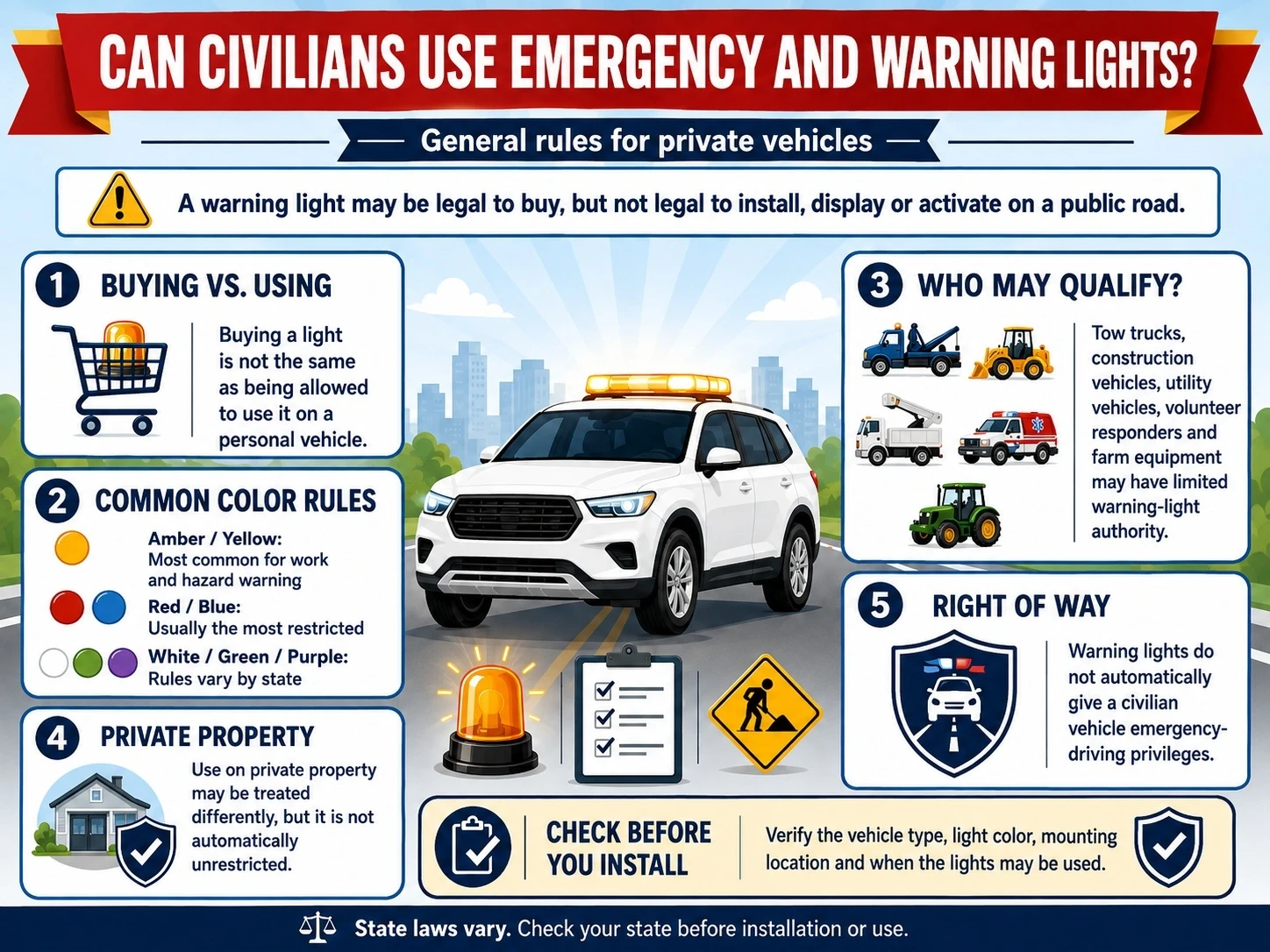
A light that is legal on an authorized work truck may be illegal on an ordinary passenger car. Before installing anything, check the rules for your vehicle and the state where it will operate.
Civilian Warning Light Laws at a Glance
This table summarizes common patterns found in state vehicle-lighting laws. It does not replace the law in a specific state.
| Question | General Answer | What Determines Legality? |
|---|---|---|
| Can civilians buy emergency lights? | Many warning-light products are available to the public. | State equipment restrictions and seller policies |
| Can civilians install flashing lights? | Installation may be regulated separately from activation. | Color, mounting location, visibility and vehicle type |
| Can civilians use flashing lights on public roads? | Only when the vehicle, color and purpose are authorized. | State statutes, permits and agency approval |
| Are amber or yellow flashing lights legal? | They are widely used for work and hazard warning. | Vehicle classification and conditions of use |
| Are red lights legal on civilian vehicles? | Red is frequently restricted to authorized emergency uses. | Direction, vehicle class and responder authorization |
| Are blue lights legal on civilian vehicles? | Blue is highly restricted, although narrow exceptions may exist. | State definitions and installation, display and activation rules |
| Are white strobe lights legal? | White may be permitted within an authorized warning system. | Flashing-light rules, mounting and direction |
| Are green or purple lights legal? | Their meanings vary by state. | The user, vehicle and purpose identified in state law |
| Can warning lights be used on private property? | Private-property use may be treated differently. | Impersonation laws, local ordinances and visibility from public roads |
| Do warning lights give civilians right of way? | Not unless state law gives the vehicle that privilege. | Authorized emergency-vehicle status |
| Can civilians use a siren? | Sirens are often more restricted than warning lights. | Vehicle classification, permit and authorized use |
Buying Emergency Lights Is Not the Same as Using Them
Extreme Tactical Dynamics has supplied vehicle warning equipment since 2005. One of the most common questions we receive is whether a product sold online can legally be used on a personal vehicle.
Purchasing, installing, displaying and activating a light can be separate legal questions. A person may be able to buy red or blue equipment but still be prohibited from displaying it on a public road. A volunteer responder may qualify to use a color that an ordinary driver cannot. A tow truck may display amber lights during a recovery, but that does not authorize the operator to use the same equipment on a personal car.
Before choosing a system, identify:
- The vehicle’s legal classification
- Why warning lights are needed
- Every color the equipment can display
- Where the lights will be mounted
- Whether they will face forward, sideways or rearward
- Whether they will operate while parked, moving or both
- Whether written authorization or a permit is required
A civilian vehicle should not be equipped in a way that causes other motorists to mistake it for a police vehicle. Colors and flash patterns associated with a police light system require especially careful review.
What Color Flashing Lights Are Legal?
There is no warning-light color that every civilian may use for every purpose in all 50 states.
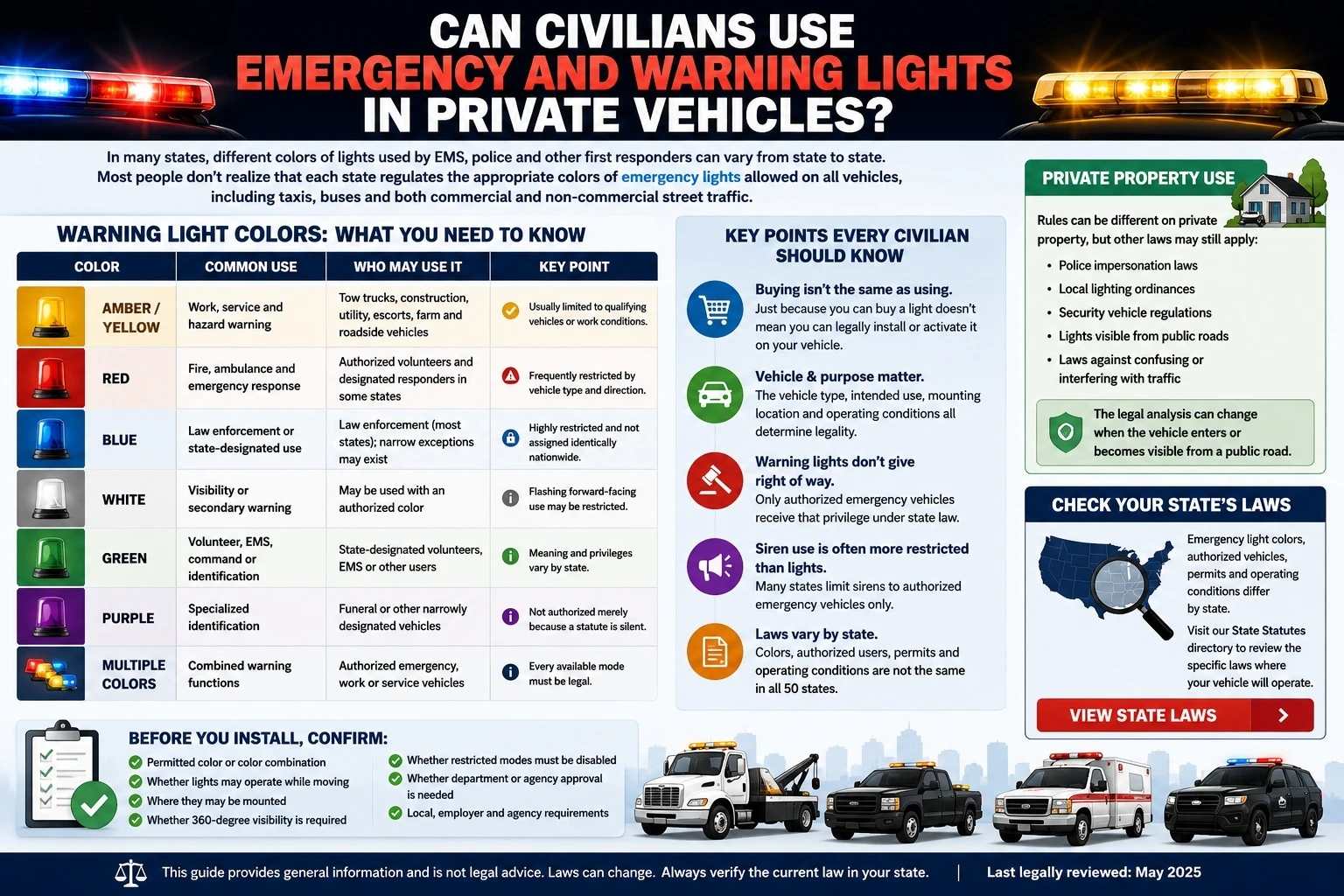
| Color | Common use | Possible civilian or non-police users | Main caution |
|---|---|---|---|
| Amber or yellow | Work, service and hazard warning | Tow, construction, utility, escort, farm and roadside vehicles | Usually limited to qualifying vehicles or work conditions |
| Red | Fire, ambulance and emergency response | Authorized volunteers and designated responders in some states | Frequently restricted by vehicle class and direction |
| Blue | Law enforcement or another state-designated use | Narrow state-specific exceptions may exist | Highly restricted and not assigned identically nationwide |
| White | Visibility or secondary warning | May be combined with an authorized color | Flashing forward-facing use may be restricted |
| Green | Volunteer, EMS, command or identification | State-designated volunteers, EMS or other users | Meaning and privileges vary by state |
| Purple | Specialized identification | Funeral or other narrowly designated vehicles | Rare and not authorized merely because a statute is silent |
| Multiple colors | Combined warning functions | Authorized emergency, work or service vehicles | Every available mode must be legal for that vehicle |
Are Red and Blue Lights Illegal on Civilian Cars?
Red warning lights and blue strobe lights are among the most restricted warning-light colors.
For an ordinary civilian with no qualifying emergency, government or volunteer role, police-style red and blue lighting may violate state laws governing vehicle equipment, emergency-light use or police impersonation.
Depending on the jurisdiction, the law may regulate:
- Installation
- Possession
- Visibility
- Display
- Activation
- Forward-facing colors
- Equipment that imitates an emergency vehicle
A restricted light does not necessarily become legal because it is mounted inside the windshield, switched off or described as being for display use.
Some states provide narrow exceptions for volunteers or other specifically authorized users. Those exceptions should never be treated as general civilian permission.
Are Amber or Yellow Flashing Lights Legal?
Amber warning lights and yellow warning lights are most commonly associated with work vehicles, service vehicles and temporary traffic hazards.
Depending on state law, they may be authorized for:
- Tow and recovery vehicles
- Construction equipment
- Highway-maintenance vehicles
- Utility trucks
- Snowplows
- Pilot and escort vehicles
- Farm machinery
- Waste-collection vehicles
- Roadside assistance vehicles
- Slow-moving or disabled vehicles
Tow and recovery operators considering tow truck warning lights must first confirm that the vehicle, activity and operating condition qualify under state law.
Amber is not a universal civilian-use color. The vehicle may need to be performing the work or activity that creates the need for the warning signal.
An amber light normally warns other motorists about a hazard or unusual operation. It does not, by itself, make a vehicle an authorized emergency vehicle or give the driver permission to ignore ordinary traffic laws.
Are White, Green and Purple Warning Lights Legal?
These colors do not have one nationwide meaning.
| Color | How it may be used | What to verify |
|---|---|---|
| White | Often used with another authorized warning color to increase visibility | Flashing front-facing rules, mounting and vehicle type |
| Green | May identify volunteer responders, EMS personnel, security vehicles or other designated users | The state-specific meaning and whether it provides traffic privileges |
| Purple | Sometimes assigned to funeral or other narrowly defined vehicles | Whether the vehicle and purpose are expressly authorized |
A standard white headlamp, reverse lamp or work light is not the same as a rapidly flashing white strobe.
Green may function as an identification or courtesy signal in one state and have a different meaning in another. Purple is used far less often and should not be assumed legal simply because a statute does not name it directly.
Are LED Strobe Lights Legal on Civilian Vehicles?
The legality of aftermarket LED strobe lights depends on the vehicle, color, mounting position and intended use.
The same product may be lawful on an authorized utility truck and unlawful on an ordinary passenger car.
Check whether the law regulates:
- Flashing, rotating or oscillating lamps
- Windshield and dashboard mounting
- Grille or surface-mounted lights
- Hideaway lights inside factory housings
- Forward-facing red, blue or white light
- Light intensity and beam direction
- Multi-color systems
- Use while parked or moving
With dual-color and multi-color products, every available mode matters. A vehicle authorized to display amber may still be prohibited from displaying blue.
An aftermarket installation should not obscure or interfere with required headlights, turn signals, brake lights, taillights or reflectors.
Federal requirements can also affect how warning equipment is installed. The National Highway Traffic Safety Administration has explained that auxiliary lighting may not impair the effectiveness of lighting required by Federal Motor Vehicle Safety Standard No. 108. Certain installations performed by vehicle manufacturers, distributors, dealers, rental companies or motor vehicle repair businesses may also be subject to the federal “make inoperative” restriction. That restriction does not apply to an individual vehicle owner in the same way, but state and local laws still control whether the lights may be displayed or used.
Primary source: NHTSA FMVSS No. 108 warning-light interpretation
Construction Vehicle Strobe Light Laws
Authorized construction vehicle lighting commonly uses amber warning lights to alert approaching drivers to roadside work, slow movement or a temporary hazard.
Authorization may depend on what the vehicle is doing at that moment. A contractor may qualify to use amber lights while working beside traffic but not during an ordinary trip unrelated to that work.
Common factors include:
- Whether the vehicle is actively performing work
- Whether it is stopped or moving slowly
- Whether it is inside a work zone
- The direction and visibility of the lights
- Permit or registration requirements
- Whether it falls within a defined statutory class
A company-owned truck is not automatically a legally recognized construction or utility vehicle for every warning-light purpose.
Can Warning Lights Be Used on Private Property?
Private-property use may be treated differently from use on a public highway, but private land is not an automatic exemption from every law.
Other rules may still apply, including:
- Police-impersonation laws
- Local lighting ordinances
- Security-vehicle regulations
- Property-owner requirements
- Rules involving lights visible from public roads
- Laws against confusing or interfering with traffic
Farmers may use warning lights on tractors, ATVs and utility vehicles to improve visibility on private land. Security companies may use warning equipment in private parking lots, industrial properties or gated communities.
The legal analysis can change when the vehicle enters, crosses or becomes visible from a public road.
Do Warning Lights Give Civilians the Right of Way?
No, not by themselves.
Permission to display an emergency vehicle light does not necessarily provide emergency-driving privileges.
Those privileges depend on how state law classifies the vehicle and what the law expressly permits the driver to do.
A work truck displaying amber lights may still be required to:
- Obey posted speed limits
- Stop at traffic signals
- Yield to pedestrians
- Remain within marked lanes
- Follow ordinary parking and stopping rules
A volunteer responder’s red, blue or green light may act only as a request for courtesy. It may not give that driver the same authority as a marked police car, fire engine or ambulance.
Can Civilians Use Sirens?
A vehicle permitted to display warning lights is not automatically permitted to use a siren. Siren authority is often limited to vehicles legally classified as authorized emergency vehicles. State law may regulate audible devices separately from visual warning equipment.
Always check both provisions.
Check Civilian Warning-Light Laws in Your State
Emergency-light colors, authorized vehicles, permits and operating conditions differ by state. Use the ETD state-law directory to review the specific rules where the vehicle will operate. Each state page explains the applicable colors, vehicle classes, statutory sources and important restrictions.
Review your state’s regulations before purchasing, installing or activating warning equipment.
When the law is unclear, contact the appropriate state police, highway patrol, motor vehicle agency or local authority.
Choose Warning Lights Only After Confirming What Is Legal
Once you know which colors and functions are authorized, choose equipment that matches the vehicle’s actual job.
A tow truck, construction vehicle or utility truck may need visible amber equipment. An authorized responder may need a specific color and mounting position. A vehicle used only on private property may need a different setup from one that regularly enters public roads.
Before ordering, confirm:
- The permitted color or color combination
- Whether the lights may operate while moving
- Where they may be mounted
- Whether 360-degree visibility is required
- Whether restricted modes must be disabled
- Whether department or agency approval is needed
After confirming the permitted color, vehicle classification, mounting position and operating conditions, compare LED warning lights designed for the vehicle’s actual job. Select equipment only after confirming that every available color and operating mode is authorized.
Frequently Asked Questions
Is it illegal to have blue lights on your car?
Blue is one of the most restricted warning-light colors and is commonly reserved for law enforcement or another specifically authorized use. Narrow exceptions may exist for designated volunteers or other users under state law. An ordinary civilian vehicle should not display blue lights on a public road without clear legal authority.
Is it illegal to have police lights on your car?
It may be illegal to install, display or activate police-style lights on an unauthorized vehicle. The exact restriction depends on state law.
Can you have red and blue lights on your car?
Authorized emergency or volunteer vehicles may qualify in some states. An ordinary civilian vehicle should not use red and blue lights without clear legal authority.
Are flashing amber lights legal?
Amber lights are widely used by qualifying work and hazard vehicles. Their use may be limited to specific vehicles, locations or operating conditions.
Can you have yellow flashing lights on your car?
Yellow is generally treated similarly to amber, but legality depends on the vehicle’s function and state law.
Is it legal to have flashing lights on a personal vehicle?
Only when the color, vehicle, mounting and use comply with the applicable law. Personal ownership does not establish authorization.
Can volunteer firefighters use lights on personal vehicles?
Many states provide specific rules for volunteer responders. The permitted colors, number of lights, authorization requirements and traffic privileges vary.
Can security vehicles use warning lights?
Security vehicles may be permitted to use designated colors, particularly on private property. They should not imitate police vehicles.
Do warning lights make a vehicle an emergency vehicle?
No. The vehicle must satisfy the legal definition and requirements for an authorized emergency vehicle.
Can civilians buy emergency lights?
Many products are available to the public. The purchaser remains responsible for the lawful installation and use of the emergency lights purchased.
How ETD Classifies State Law
ETD does not treat statutory silence as permission.
- Expressly authorized
- Expressly prohibited
- Restricted by a broader provision
- Limited to a defined vehicle or user
- Subject to written authorization
- Not expressly addressed
- Unclear from the reviewed authority
“Not expressly addressed” does not mean legal. Likewise, “not expressly authorized” does not always establish that a use is prohibited. Another statute, regulation, definition or local rule may apply.
Research Method, Sources and Legal Notice
This guide provides general educational information and is not legal advice.
Extreme Tactical Dynamics reviews primary sources when preparing warning-light content, including official vehicle statutes, authorized emergency-vehicle definitions, lighting provisions and agency guidance. Federal equipment and installation requirements are reviewed separately from state authorization and road-use laws. We separate direct statutory requirements from broader national patterns and do not treat statutory silence as permission.
Representative primary sources reviewed for this national guide include:
- NHTSA FMVSS No. 108 Warning-Light Interpretation
- Florida Statutes §316.2397
- New York Vehicle and Traffic Law §375
Laws can change. Confirm the current state, federal and local requirements before purchasing, installing, displaying or activating warning equipment.
Written by Chris Dallmann, Owner, Extreme Tactical Dynamics.
Editorial and statutory review completed by Extreme Tactical Dynamics using official federal and state sources. No legal representation or attorney-client relationship is created.
Last legally reviewed: August 2026